
How the Modesto Residents Directory Works
Different records answer different parts of a resident question. A parcel number and a deed differ. So do a directory line and a court docket. Each carries its own evidence. The Stanislaus County Assessor and its GIS viewer can tie a parcel to a situs address, an APN, and an owner display. This works when law and portal settings allow it. The Clerk-Recorder's index links names to deeds, liens, maps, and other recorded instruments. A directory entry or census schedule can reveal an occupant who never owned the land. Court, vital, business, license, obituary, and probate records add dates and relationships. Those details help separate people who share a name.
A Modesto residents directory question works best this way. The clue and the record's role stay together. Names can match while people differ. An owner and a deed party may differ. So may a directory occupant, a business principal, and a court party. They can all be different people.
Start with the strongest fact in hand. An address calls for parcel and map work. A full name invites a narrow RecorderWorks search. Then add a second source such as a court docket, directory entry, or business filing. Family-history questions may fit the Modesto Library's Stanislaus Room better than a modern portal. Treat no single result as proof of a current household. Always check the record's date, role, and access limits.
- Normalize the name or address and keep every spelling, unit, direction, and surname variant.
- Use the county property lookup or Modesto GIS to anchor an address to a parcel and jurisdiction.
- Search RecorderWorks for the party or document, then read the legal description and recording date.
- Use the court, vital, voter, license, business, directory, or obituary source that fits the question.
- Ask the custodian for a defined existing record when the web index stops.
Modesto's Records Offices
Modesto serves as both a city and the Stanislaus County seat, which means several useful records custodians operate near the county-seat core on separate systems. The Clerk-Recorder, located at 1021 I Street, Suite 101, handles deeds, liens, maps, fictitious business names, marriages, and other recorded instruments. The office also issues official-record copies and vital certificates. Its public counter welcomes visitors on weekdays from 8 a.m. to 4 p.m., excluding holidays. The listed phone number is 209-525-5250, with a Spanish line at 209-525-5252. For a filed instrument rather than a general question, the Stanislaus County Clerk-Recorder is the right first stop, and a Modesto residents directory search often points back to this same office as the custodian of record.
Stanislaus County Clerk-Recorder
1021 I Street, Suite 101
Modesto, CA 95354
209-525-5250
RecorderWorks official index
Stanislaus County Assessor
Parcel, situs, mailing, value, and use data
Public lookup plus counter access
Agency Inquiry: $300 yearly
County property lookup
Stanislaus County Elections
1021 I Street, Suite 101
Modesto, CA 95354
209-525-5200
Voter-file rules
The Clerk-Recorder office page identifies the county's central record custodian and its downtown counter. It doubles as a visual route reference.
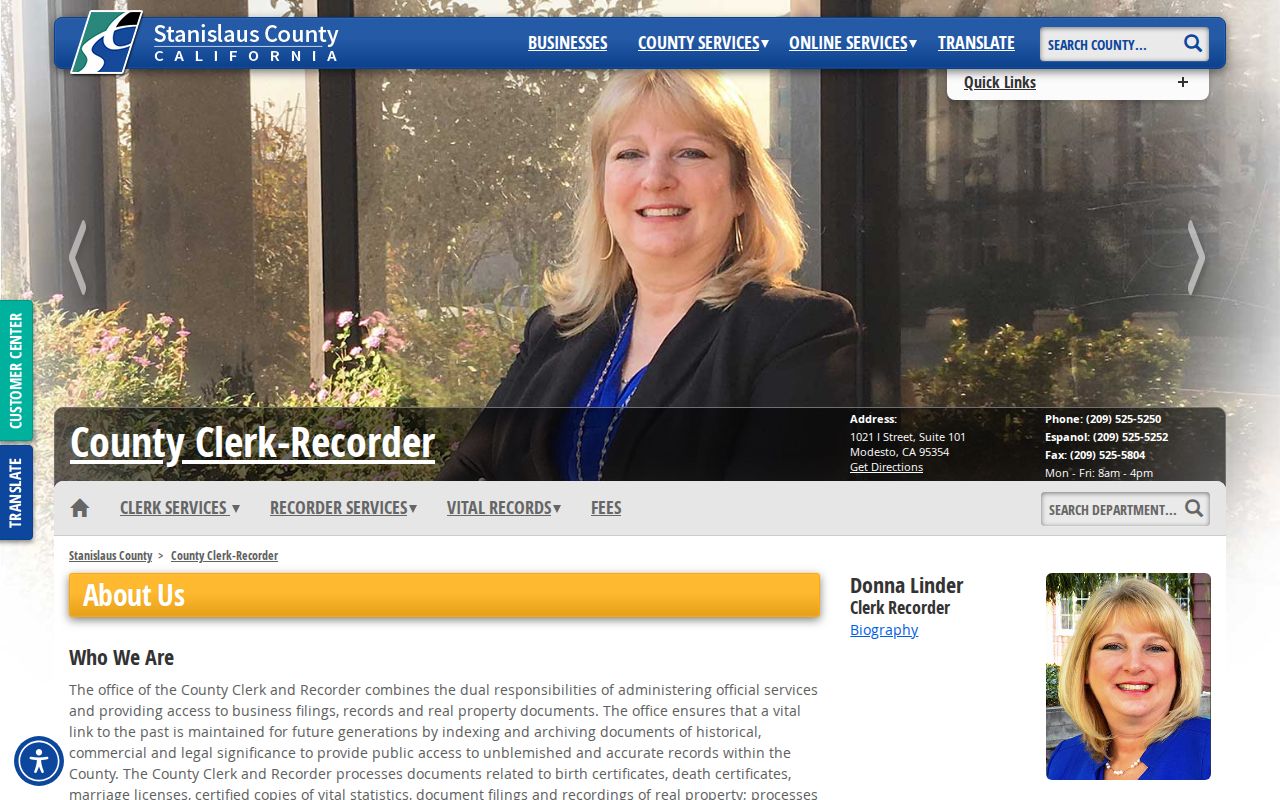
Confirm current hours and copy rules before a visit. The Assessor establishes taxable ownership and value. The Recorder proves the recorded chain. Elections handles registration and qualified file requests, not an anonymous by-street resident list. The city Clerk, Building Safety counter, Police Records unit, and Modesto Library each fill different gaps. None is a general directory desk. Together they form the working record trail behind a Modesto residents directory, with each office limited to its own record set.
RecorderWorks Reaches Back to 1850
RecorderWorks advertises an index that begins January 1, 1850. That reach is a valuable lead. For a Modesto resident search, though, remember that an index date is not a downloadable image date. The county's older guide documents computer index and image coverage from 1978 forward. Paper and microfilm grantor-grantee indexes overlap that span, covering 1920 through 1988. Earlier books require manual work. Stanislaus County itself was created in 1854. So an early hit needs an instrument and jurisdiction check before anyone treats it as a county record.
Use the Name tab for a party search. The county allows a last name alone, though a partial first name can keep a broad query from timing out. Search a narrow recording range. With an exact identifier, use a document number search. Search the year the instrument was recorded, not just the year of the sale or family event. The RecorderWorks search screen is the practical starting view for the name and document tabs described here.
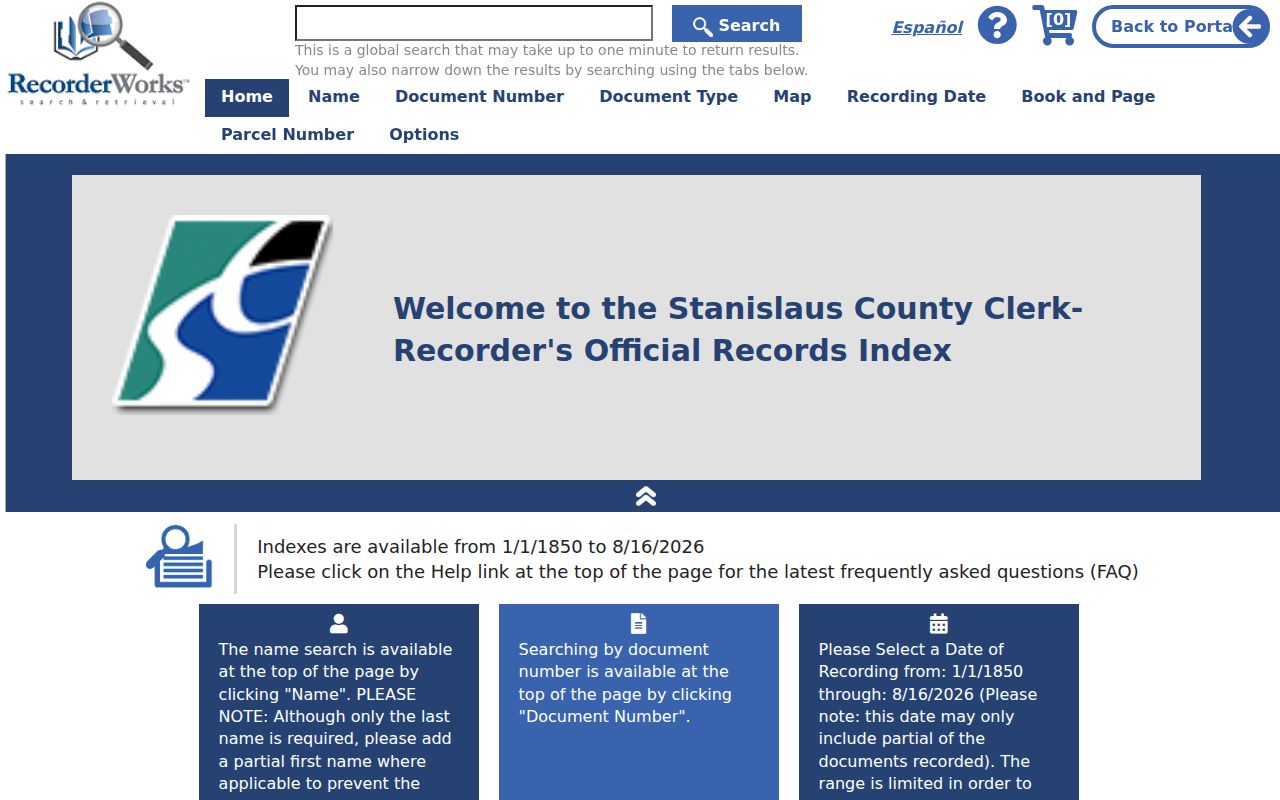
The RecorderWorks screen pairs party search and document-number search.
| RecorderWorks field | How it works in Modesto |
|---|---|
| Last Name | Required for the Name tab; a surname-only search is allowed. |
| First Name | Optional; a partial first name can narrow a common surname. |
| Beginning / Ending Recording Date | Required date range for a name search; keep it limited for speed. |
| Document Number | Use the separate tab or field for an exact instrument search. |
| Recording Date | Pair with a document number when the portal requests it. |
Results can show party name and role, recording date, document type, document number, book and page where applicable, page count, and an image indicator. The image itself may carry more. Look for the APN, a legal description, transfer-tax wording, or redactions the row omits. A grantor is the seller or transferor. A grantee is the buyer or transferee. On a trust deed, those roles usually describe borrower and beneficiary rather than a sale.
From a Modesto Address to a Deed
Treat an address search as a chain, not a verdict on who lives there. Start with the house number and street in the Stanislaus County property lookup. Write down the APN and the normalized situs. Then compare that same location in Modesto GIS. County parcels, Master Addresses, jurisdiction, zoning, aerial, and district layers can all be switched on there. Clicking a polygon sometimes exposes a parcel sequence. It may sit behind a corner lot, a rear parcel, or a multi-address complex.
Carry any visible owner name or document clue into RecorderWorks. Before joining two records, confirm the APN or legal description on the image itself. City permit history, code cases, and subdivision maps answer questions about a building. They also cover a site change. The city GIS catalog goes further. It layers in business licenses, council districts, schools, public-safety data, FEMA flood zones, census blocks and tracts, and development activity. That geography adds real context. It still cannot turn a parcel into a household list.
- Roll
- An agency list or account record, such as a property or voter roll, built for a defined public purpose.
- Index
- A finding aid with names, dates, and document clues. It may point to an image without containing the full instrument.
- Parcel
- A mapped piece of land identified by an APN. One parcel can hold several units and households.
- Criss-cross directory
- A historical directory section arranged by street and number rather than only by surname.
For a full address-by-address walkthrough, see Modesto by-street records, which lays out the GIS controls and address sources in greater detail. It is the natural next step once a single address has been pinned down.
Why Modesto Lacks an Open Roll
California offers no single public screen that lists every Modesto resident by street. The voter-status tool authenticates each person against personal details rather than exposing a roll. Voter files go out only for qualified purposes. They fall under Elections Code sections 2188, 2194, and 18109, Government Code section 7924.000, and related regulations. Utilities keep no public customer directory. DMV personal data stays restricted. The Driver's Privacy Protection Act and California vehicle-law provisions govern it. Renter and household-member names rarely reach a parcel roll at all.
The California My Voter Status entry point shows the model plainly. It asks you to prove who you are, not to browse a street list.
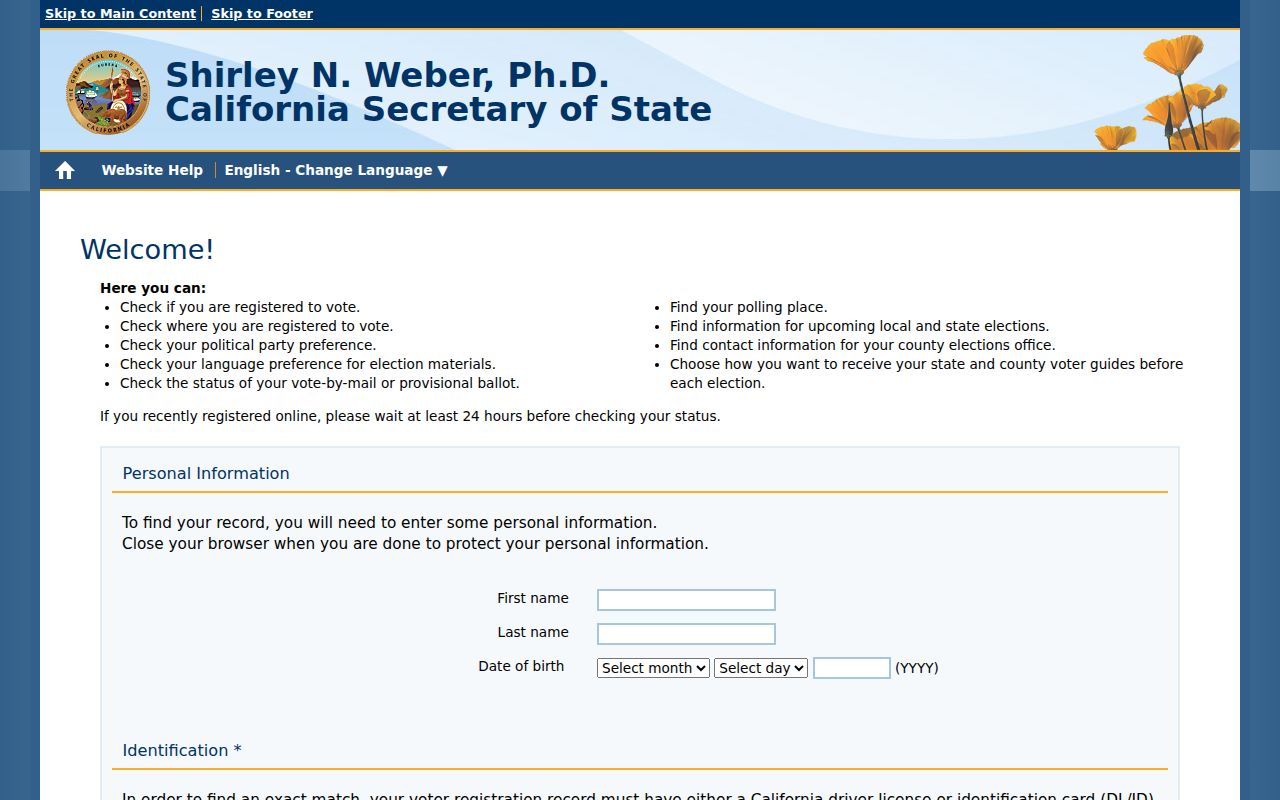
The voter-status image is a useful reminder. A self-check and an approved voter-file request are two different access paths.
This gap is not a failed search. It signals that a narrower question needs a narrower source. A property record ties an owner to a parcel on a date. A directory edition lists a household member for that year. A court docket shows a party role. None of those alone proves someone currently lives at an address. So match records to their own moment. Safe at Home and other confidential voter protections add a further caution. A missing address may be deliberate.
Lawful personal use. Modesto records are useful for family history, civic research, property questions, and reconnecting with people through proper channels. Do not use an address or identity trail to stalk, harass, intimidate, or harm anyone.
Current Modesto Residents Directory Sources
"Directory" is a plain, useful word. The current sources do not all list the same people, though. Owners, registered voters, deed parties, permit applicants, business principals, and licensed professionals each hold a different role, and a strong Modesto residents directory search names the role the record actually shows. Every result also keeps its date.
| Source | Who may appear | Keeper | Access |
|---|---|---|---|
| Assessment parcel | Owner or ownership code, situs, mailing, value | Stanislaus Assessor | Public lookup, counter, subscription limits |
| Recorder index | Grantors, grantees, lien and map parties | Clerk-Recorder | Free index; images and copies vary |
| My Voter Status | The authenticated voter | California Secretary of State | Personal sign-in, not a public list |
| City permit history | Applicants, contractors, project contacts | Modesto Building Safety | eTRAKiT, counter, or records request |
| Business and license filings | Entities, agents, licensees, public business contacts | State, county, and city offices | Public portals with role limits |
The best source depends on the question. Ownership belongs to the Assessor and Recorder. A project question points to eTRAKiT and GIS. A historical household question calls for directories, census, newspapers, or the Stanislaus Room. To match a person, gather two independent points, such as an APN, a spouse, an occupation, an exact date, or a legal-description chain.
Modesto Court Records Need a Name Check
The Stanislaus Superior Court serves as Modesto's trial court. Its online-services gateway opens party and case searches across civil, criminal, traffic, family, probate, small claims, juvenile, and related matters. Search by case number or party name. Adding a first name, case type, and filing date range sharpens the results. Federal cases from the area sit in the Eastern District of California, reachable through PACER. That service requires registration and charges federal document fees.
A public result may display a case number, caption, type, filing date, status, courthouse, party role, attorney, hearing, register-of-actions entry, document title, and filed date. Remote image access hinges on the document and the user role. California Rule of Court 2.503 narrows remote access to many criminal, family, juvenile, probate, guardianship, conservatorship, mental-health, and restraining-order records. A courthouse terminal or the clerk can supply lawful nonremote detail. Sealed and confidential material stays closed either way.
A vendor address or case-search link may shift over time. The Stanislaus Superior Court online-services page remains the authoritative gateway. Start there.
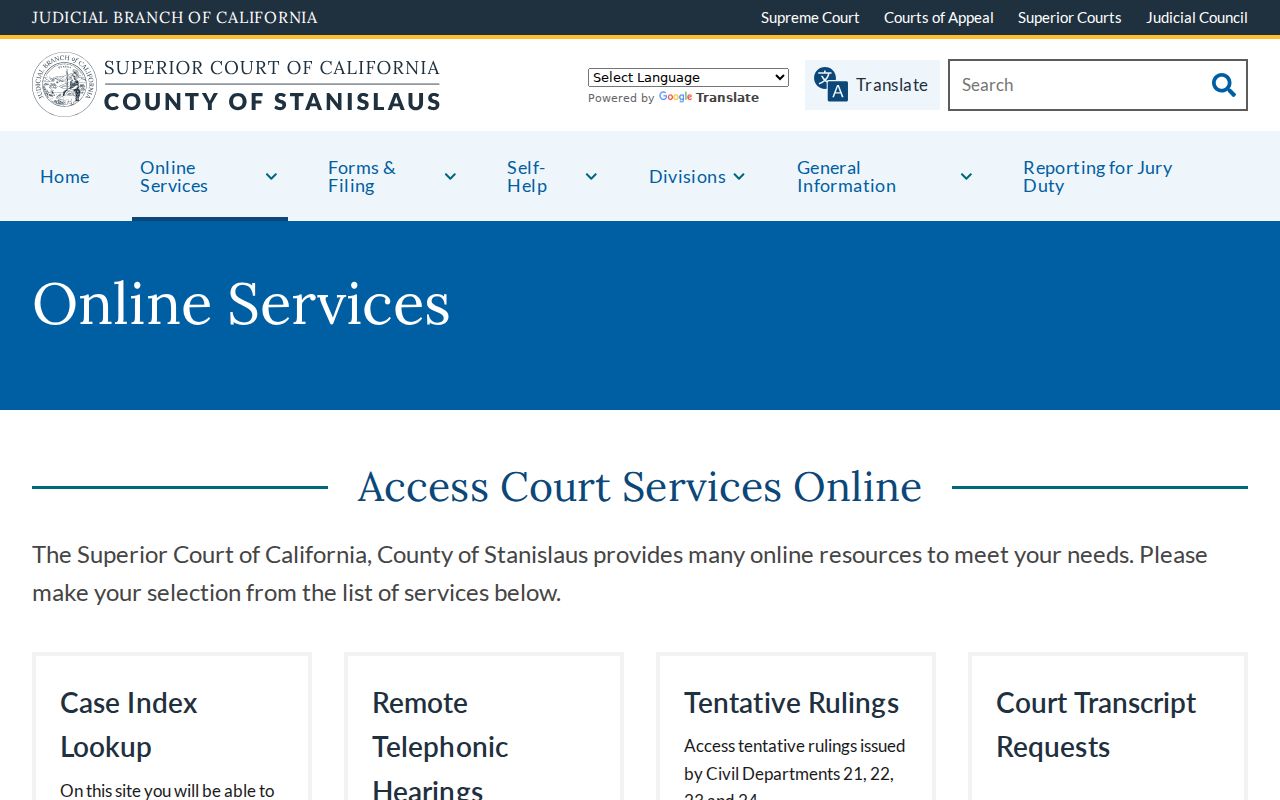
The court image reinforces the pattern. Begin at the court's own service gateway, then check remote-access limits before expecting detail.
Same-name discipline matters most in court work. A court party and a deed grantee may share a common name. They are not automatically one person. Keep the spelling, middle initial, suffix, address clue, date range, and case type bundled together. Read the actual order before describing any outcome. For an heir question, a public probate petition can identify a decedent and a petitioner. It can also identify heirs or devisees, and mailing addresses.
Modesto Vital Records Have Different Access
California splits vital-record access into two tracks rather than one age rule. Birth, death, and public-marriage records offer an informational copy. That copy is marked not valid to establish identity. An authorized certified copy goes only to listed relationships and other permitted categories. A sworn statement may be required. Confidential marriage records stay with the county. They reach only a party or a court order. Adoption files are confidential under Family Code section 9200.
The county Clerk-Recorder handles certificates and marriage licenses locally. For statewide applications, the California Department of Public Health Vital Records is the route. Effective January 1, 2026, state fees run $31 for a birth certificate. Death costs $26, marriage $19, and a dissolution certificate $18. If no record turns up, the state keeps the fee as a search fee. Mail payment goes by check or money order, never cash.
A birth application asks a lot. Expect the registrant's name, date and place, and parent names. Add applicant details, number of copies, relationship, purpose, and the proper sworn statement. The copy type you choose at the start controls the access path. For divorce, remember the split: court files hold the full case and judgment. A CDPH dissolution certificate is only a limited record of the event, not the decree.
When a Modesto Search Leaves the Web
The California Public Records Act, Government Code sections 7920.000 and following, opens identifiable existing agency records unless an exemption applies. Scope your request well. Name a record, date range, address, or case number. The agency normally decides within 10 calendar days whether disclosable records exist, and unusual circumstances can extend that by 14 days. Inspection is ordinarily free. Direct duplication may cost extra.
Local fallback paths matter when the web runs dry. The Clerk-Recorder offers public terminals, staff copy procedures, and a mail official-record request form. Modesto departments also take official-document requests through the city Form Center. The Superior Court clerk can pull an archived file when your request names the case and document. The Modesto Library at 1500 I Street keeps a supervised Stanislaus Room with local histories, genealogy, directories, newspapers, yearbooks, church pictorial directories, and vertical files. Ask about noncirculating materials and access before you travel.
Note: A custodian can explain its index and access rules, but it need not create a new resident list or conduct open-ended genealogy.
Historical Modesto Residents Directory Sources
Modesto's city-directory trail begins by at least 1910. It runs nearly annually through 1935 and continues in selected editions through 1985. NARA lists a Modesto, Stanislaus County, and Turlock microfilm run covering 1928 through 1933. Polk's editions reach farther, taking in Oakdale, Ceres, Denair, Hughson, Keyes, Riverbank, and Salida. Telephone books add a second address-and-name series from 1945 into the early 1960s.
A single entry can carry a surname, given name or initial, spouse, widow mark, occupation, employer or business, home mark, roomer or boarder mark, and street address. A criss-cross section flips the path and looks up by street and number. Read the keys carefully. "h" marks a home at that address in that edition, not necessarily ownership. "r" or "bds" may flag a resident or boarder depending on the volume's key. A historical Modesto residents directory is a dated snapshot, never a complete household list. Pair its address with a census year, deed, obituary, or newspaper before you draw conclusions.
The Modesto city directory collections page treats the historical shelf in full, including how to read a volume and bridge wartime gaps.
Modesto Heir Research Through Probate
Probate is one of the clearest lawful routes for an estate or family connection question. A public petition can identify the decedent, petitioner, fiduciary, heirs or devisees. It sometimes gives mailing addresses. The Recorder does not hold every will merely because it exists. A will becomes a court record only when lodged or filed in a probate proceeding. Start with a name and an approximate date. Then compare the docket against an obituary, a deed transfer, and cemetery or newspaper evidence.
Each record plays a different role. An obituary can supply relatives plus a service or cemetery clue. A deed can show a later transfer to an heir. A newspaper report never substitutes for a court order. A same-name heir still needs a second point. That point might be an address, spouse, occupation, or exact event date. The California State Controller's unclaimed-property search can add a past Modesto city association. It does so without publishing a full current address.
Modesto Names, Languages, and Indexes
Modesto counted 218,464 residents in the 2020 Census. The Census Bureau's July 1, 2025 estimate was 219,652. The city's population history and agricultural economy teach a practical search lesson. A name may appear with a compound surname or a diacritic. It may use a married or birth surname. It may use initials or an anglicized given name. Search the recorded spelling first. Then test hyphenated and unhyphenated forms and both surname components.
Spanish, Portuguese, Assyrian, and other community records can surface across churches and newspapers. They also appear in civil indexes, schools, and business filings. An index variation is a lead, not proof of identity. Compare dates, spouses, occupations, addresses, and family links before committing. The Census QuickFacts profile for Modesto adds population context. Local newspapers such as The Modesto Bee can connect marriages, obituaries, organizations, court reporting, and development history. Record the publication date and page for each item.
Modesto Business and License Trails
A business filing is a start. It proves a tie to a firm, not a home. The California Secretary of State's bizfile search covers corporations, LPs, and LLCs. You can search by name or entity number. Each result lists status, formation date, jurisdiction, addresses, and the agent for service. Statements of Information and filing history appear too. Sole proprietors often turn up in county fictitious-business-name filings instead.
Licenses tell another story. The Department of Consumer Affairs search takes a board, license type, or license number. It also accepts business name, person, city, county, or ZIP. A match can return the licensee and status. It may show address of record, issue and expiration dates, and discipline links where posted. Modesto adds its own trails. A business-license GIS layer, City Finance or Business Tax records, contractor files, food-facility records, and professional-board data can tie a name to a firm or project. None of them yields a home address.
Protective Records in Modesto
Some records are hidden for good reason. California's Safe at Home program gives qualifying survivors and others who fear for their safety a substitute mailing address with mail forwarding. Enrolled members also gain confidential voter registration. So do other protected classes. A blank owner or mailing field is a deliberate shield. Rebuilding it from deeds, maps, licenses, or family clues defeats that protection.
Privacy law offers another lever. CCPA and CPRA rights support access, deletion, correction, or opt-out requests for covered data. The Delete Act adds data-broker deletion infrastructure. None of this erases what a public custodian keeps. Even a full Modesto residents directory can omit a protected address or misstate a record role. The office holding the record fixes errors: the Assessor for ownership roll issues, the Recorder for indexing, the court clerk for docket errors, Elections for voter records. Vital-record amendments belong with the county and state offices that issue certificates.
Note: The most reliable correction starts with the custodian's record, not with a search result that repeats it.