
Modesto Previous Residents: APN First
A past-resident search works best when the address is converted into an APN and legal description before names are chased. The Stanislaus County property lookup and Modesto GIS establish the parcel, situs, jurisdiction, and map context. The county Assessor supplies ownership and value information where the display permits it, while the Clerk-Recorder supplies the recorded chain. A mailing address is not the same as a situs address, so a tax-mail destination is only a clue.
The table separates index reach from image reach and owners from occupants. A date range in RecorderWorks does not promise that every historic page can be viewed online.
| Source | Years It Covers | Where Held | What It Shows |
|---|---|---|---|
| RecorderWorks index | Advertised 1850-present | Online county portal | Parties, dates, document types, and chain clues |
| Computer index and images | 1978-present | Online where enabled; public office terminals | Readable instruments, legal descriptions, and linked images |
| Grantor/grantee books | 1920-1988 overlap; earlier manual books | Clerk-Recorder office and older county volumes | Manual name-chain research before dependable image access |
| Modesto city directories | 1910 onward, selected runs through 1985 | Library, genealogy collections, and research databases | Listed occupants, spouses, occupations, and addresses |
| NARA city directories | 1928-1933 | NARA inventory and microfilm | A bridge around the 1930 census |
| Federal census | 1850-1950 public | NARA, FamilySearch, and library databases | Household members, status, birthplace, and enumeration district |
| Permits and aerials | Permit start not verified; aerials through 2025 | Modesto Building Safety, eTRAKiT, and GIS | Construction, alterations, structures, and parcel change |
| Sanborn maps | Exact Modesto years not verified | Library of Congress and local research libraries | Footprint, material, use, and old address context |
Start recent work with the parcel and RecorderWorks. Use directories and census schedules for earlier households, then add permits, aerials, maps, and newspapers for the building.
Modesto Past Residents: Deed Chain
The deed chain is the ownership spine of a house history. Search the current owner as a grantee, inspect the deed, then take its grantor back into the index as a prior grantee. The Stanislaus County grantor-grantee search guide explains the local party roles and date limits. The recorded instrument, not a search-result name alone, supplies the legal description and document number needed to test whether two entries concern the same parcel.
Use a narrow recording-date range when possible. RecorderWorks requires a last name and date range for a name search, permits a partial first name, and also offers document-number and recording-date paths. A name can appear in more than one role, and one person can hold more than one parcel.
- Pull the current APN, situs, and any visible owner information from the county property lookup and GIS.
- Search that owner as grantee around the likely purchase year, then inspect the deed for grantor, date, document number, and legal description.
- Verify the same APN or legal description before moving backward. Similar names and nearby parcels can create a false match.
- Search the prior grantor as grantee to find when that party acquired the parcel, and repeat the sequence.
- When the trail reaches older years, move from online results to office terminals, grantor/grantee books, microfilm, or a records request.
- Grantor and grantee
- The grantor transfers an interest. The grantee receives it. On a trust deed, the roles can instead describe a borrower and a beneficiary.
- Chain of title
- The linked recorded transfers that show how an interest moved from one party to another.
- Legal description
- The parcel’s formal lot, block, or metes-and-bounds wording. It is more durable than an old street number.
Modesto Previous Residents: Trust Deeds
Not every instrument in a deed search marks a change of owner. A grant deed or similar conveyance can transfer title. A trust deed secures a loan. A reconveyance releases that security interest after the debt is satisfied. A quitclaim can change an interest without a conventional sale. Treating each indexed document as a new household would distort a Modesto past-resident trail.
Read the document type, recording date, party role, book or page when shown, and image indicator together. RecorderWorks may show the party and index details in the result row while the legal description and APN appear on the image. Military-discharge records and other confidential material can have special access limits.
The Clerk-Recorder fee schedule lists ordinary copy-machine or microfilm copies at $3 for the first page and $2 for each added page, plus a $5 record search fee per file. Payment may be cash, qualifying check, or money order payable to Stanislaus County Clerk-Recorder.
Fees cover retrieval, not proof of residence. Occupancy needs a directory, census, obituary, permit, or other source. The county’s official-record copy request form provides a mail route; give staff a document number, date, party, and property description.
Modesto Records: Index or Image
Comparison: RecorderWorks currently advertises an index beginning January 1, 1850. The county’s older guide documents computer index and image coverage from 1978 forward, with overlapping grantor/grantee books for 1920-1988 and earlier books requiring manual work. Those are different claims. A deep online index can point to a record even when the page image is not online, not legible, or subject to an access rule.
Insider tip: Public terminals support research, while copies are ordered through staff or inside office terminals. The Stanislaus County Clerk-Recorder is at 1021 I Street, Suite 101, Modesto, and the research notes list weekday hours of 8 a.m. to 4 p.m., excluding holidays, with 209-525-5250 and Spanish service at 209-525-5252. Call before travel because counter procedures and fees can change.
Record the indexed party, role, date, document type, number, legal description, APN, image status, and search date. That keeps an index clue separate from an official copy. The county’s illustrated grantor-grantee guidance shows the path from an index result toward the underlying record.
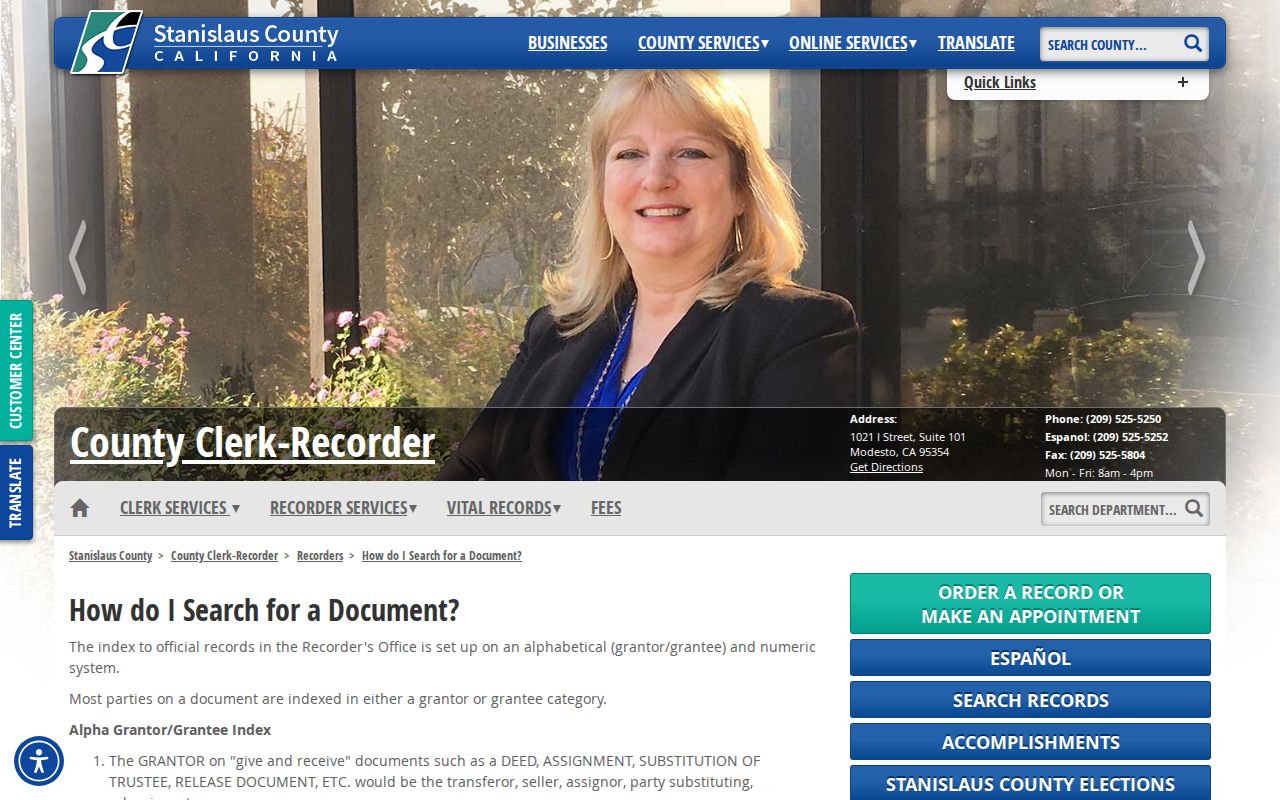 The guide image reinforces the key practice: party names and dates are entry points, while the instrument and legal description carry stronger parcel evidence.
Modesto Previous Residents in Directories
Modesto’s verified directory trail begins in 1910. The strongest run covers 1910-1935, 1937-1942, and selected later years through 1985. Polk’s Modesto and Stanislaus County editions later included Turlock, Oakdale, Ceres, Denair, Hughson, Keyes, Riverbank, and Salida. The collection itself is best handled through the Modesto city directory collections page and its library routes.
Read the alphabetical entry first. Record surname, given name or initial, spouse in parentheses, widow notation, occupation, employer or business tie, home marker, roomer or boarder marker, and street address. Then check the criss-cross section, where available, by street and number. “h” may mean home at the address, not ownership, while “r” or “bds” can reflect an edition’s own abbreviation key.
Telephone books add a second name-and-address series from the mid-1940s. They can fill a missing annual directory, but a gap is not proof that a household left. Keep the volume title and page because conventions change.
Modesto Households in Census
Directory entries name listed occupants. Census schedules add household members, relationship, birthplace, and enumeration-district context. Pair directory and census years from 1910 through 1950, allowing for publication lag and comparing spouse, occupation, and nearby names.
NARA and library databases hold the released schedules. The NARA inventory identifies a Modesto, Stanislaus County, and Turlock microfilm run for 1928-1933, making the 1930 period a useful cross-check.
- Transcribe every same-name directory candidate, including middle initials, spouse, occupation, and address.
- Check the street or criss-cross section and note nearby numbered entries.
- Search the matching census year by household and enumeration district, then compare names, ages, relationships, and birthplace.
- Move one directory edition backward and forward to spot first appearance, a move, a widow notation, or an occupation change.
An enumeration district is a census-taker’s assigned area, not a parcel boundary. Same-name households still need two matching points before they are merged.
The 1948 Modesto Address Bridge
The 1948 countywide Master Plan of Property Numbering is a key bridge when a historic address does not match a modern number. The plan generally assigns one number per 25 feet of frontage, with odd numbers to the north or west and even numbers to the east or south, subject to stated exceptions. Principal entrances and multiple units can affect the assigned number.
Do not force an old directory entry into a modern street search by number alone. Compare the legal description, APN, lot and block, subdivision map, parcel geometry, newspapers, and nearby names. Annexed territory had to conform to the county plan, but the legal lot or metes-and-bounds description remains the stronger continuity key.
Modesto Past Residents: Permits
Permits and aerials help date the place where previous residents lived. Modesto’s permit pages point to eTRAKiT and Building Safety records. A permit may name an applicant, contractor, project, date, or inspection, but not the occupant. Aerials can show a structure or addition changing over time without naming a household.
Use the city online-services page and Building Permits page after normalizing the parcel. The GIS catalog includes parcels, Master Addresses, jurisdictions, districts, flood layers, and annual aerials through 2025. Preserve the layer name and date because the city disclaims continuous availability and accuracy.
Sanborn maps can add footprint, material, use, and address context, but exact Modesto sheets and years were not verified in the research. Search the Library of Congress Sanborn collection and ask a library reference desk before assuming a sheet exists. A research gap is better recorded than filled with a guessed map year.
Modesto Past Residents: Endpoints
Obituaries, cemetery records, and probate can close a previous-resident trail when someone dies or an estate changes hands. An obituary may connect relatives, a funeral, a cemetery, or a former address. Probate can identify heirs and petitions, while a later deed can show how an interest moved. An obituary alone does not prove title.
Use the Stanislaus Superior Court online services for basic case paths, then ask the clerk about documents not remotely available. The Modesto Bee, library databases, cemetery offices, death indexes, and local clippings add context. California vital records still distinguish informational from authorized copies.
For a death record, the county Clerk-Recorder or California Department of Public Health may be the custodian. An informational copy is marked as not valid for identity. Authorized copies require a permitted relationship and, for mailed requests, a notarized sworn statement.
Modesto History Desk Fallback
Insider tip: When a web search stops, the Stanislaus Room is the practical fallback for noncirculating directories and local-history material. Request titles and years before travel. Ask for reverse directories, telephone books, yearbooks, obituary indexes, county histories, cemetery publications, church pictorial directories, and newspaper microfilm.
The Stanislaus County Library and Genealogical Society of Stanislaus County can point to holdings and research support. Call ahead because supervised-room hours, noncirculating volumes, and licensed databases may differ from branch hours. FamilySearch catalogs can bridge a missing volume, but catalog absence does not prove loss. House-history work is lawful personal research, so keep a source note, stop at protected records, and describe previous residents as people associated with a place in a dated record, not a current roster.
Source: the county fee schedule gives the copy and search framework used when a terminal result needs an official paper trail. 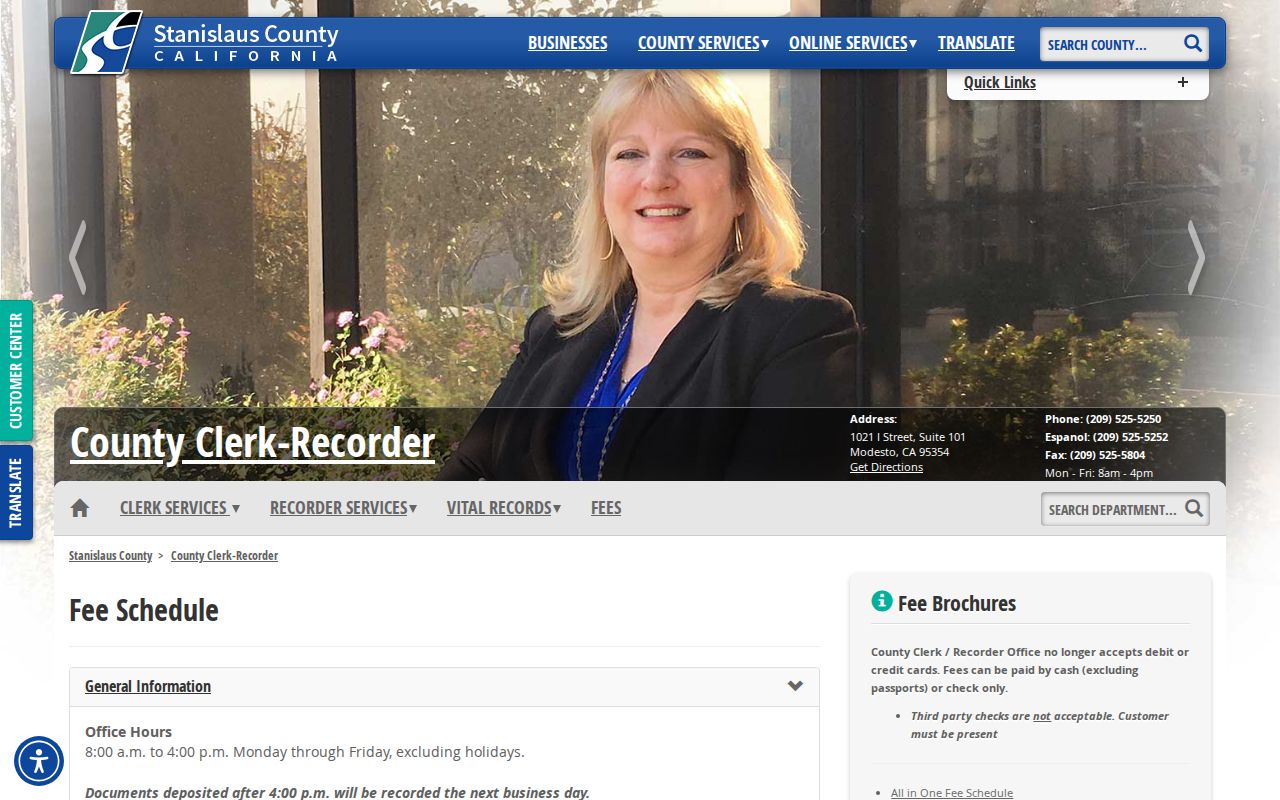 The fee notice image is a reminder to check the current schedule before ordering copies or planning an office visit.
Lawful house history. Modesto records can support family history, heir research, civic use, and personal curiosity. Do not use a past-resident trail to stalk, harass, threaten, or harm anyone, and confirm important facts with the office that holds the record.