
Modesto City Directory Collections
Modesto’s directory trail begins by at least 1910 and reaches well into the late twentieth century. The early city directories are not one uninterrupted online series. They appear through established library and genealogy catalogs, subscription databases, research libraries, and archive workflows. The coverage below keeps the known runs together so a researcher can choose a source before searching a name.
| Collection | Years | Publisher or keeper | Where held | Access |
|---|---|---|---|---|
| Modesto city directories | 1910-1935; 1937-1942; 1946; 1948; 1950; 1952-1960; later years including 1961-70, 1972, 1974, 1977-81, 1985 | Cataloged city-directory publishers | Ancestry, FamilySearch catalog, Allen County Public Library, and other research libraries | Library or database access |
| NARA city-directory microfilm | 1928-1933 | National Archives inventory | NARA directory microfilm research process | Archive or regional research access |
| Polk’s Modesto/Stanislaus directories | Various mid-century editions; the 1960 edition includes Turlock, Oakdale, Ceres, Denair, Hughson, Keyes, Riverbank, and Salida | Polk’s | FamilySearch Library catalog and genealogy libraries | Catalog and in-person research |
| Telephone white and yellow pages | Nov. 1945-Feb. 1948; Nov. 1948-May 1950; Mar. 1951-Feb. 1952; county 1953-55, 1956-58, 1959-60, 1961-62 | Telephone directory collection | Library of Congress | Historical collection access |
| Local-history and genealogy books | County formation onward; includes 1938 local-history material | Library and community publications | Modesto Library Stanislaus Room | Supervised local-history access |
| Federal census | 1850-1950 released; 1960 scheduled 2032 under the 72-year rule | National Archives | NARA, FamilySearch, and library databases | Released years and research databases |
| Modesto Bee and local papers | Historic print, microfilm, and database coverage varies | Modesto Bee and local papers | Library subscriptions and California newspaper collections | Coverage varies by title and year |
| Sanborn maps | Exact Modesto sheets and years not confirmed | Library of Congress search | Library and state collections | Verify catalog coverage first |
Gaps are part of the evidence. The verified city-directory run has interruptions around World War II and selected later years rather than a complete annual set. A missing edition does not prove that a resident left Modesto. Telephone runs can bridge some of those breaks, while the Modesto Bee and other local newspapers may supply an obituary, marriage notice, community item, or address clue. Exact Modesto Sanborn map sheets and years were not confirmed in an official catalog during the research run, so map availability should be checked rather than assumed.
For demographic context, the Census QuickFacts record for Modesto provides an official civic reference point. The image below represents that public context, not a resident list. It helps separate a city-wide statistic from the household-level detail that historical city directories can show.
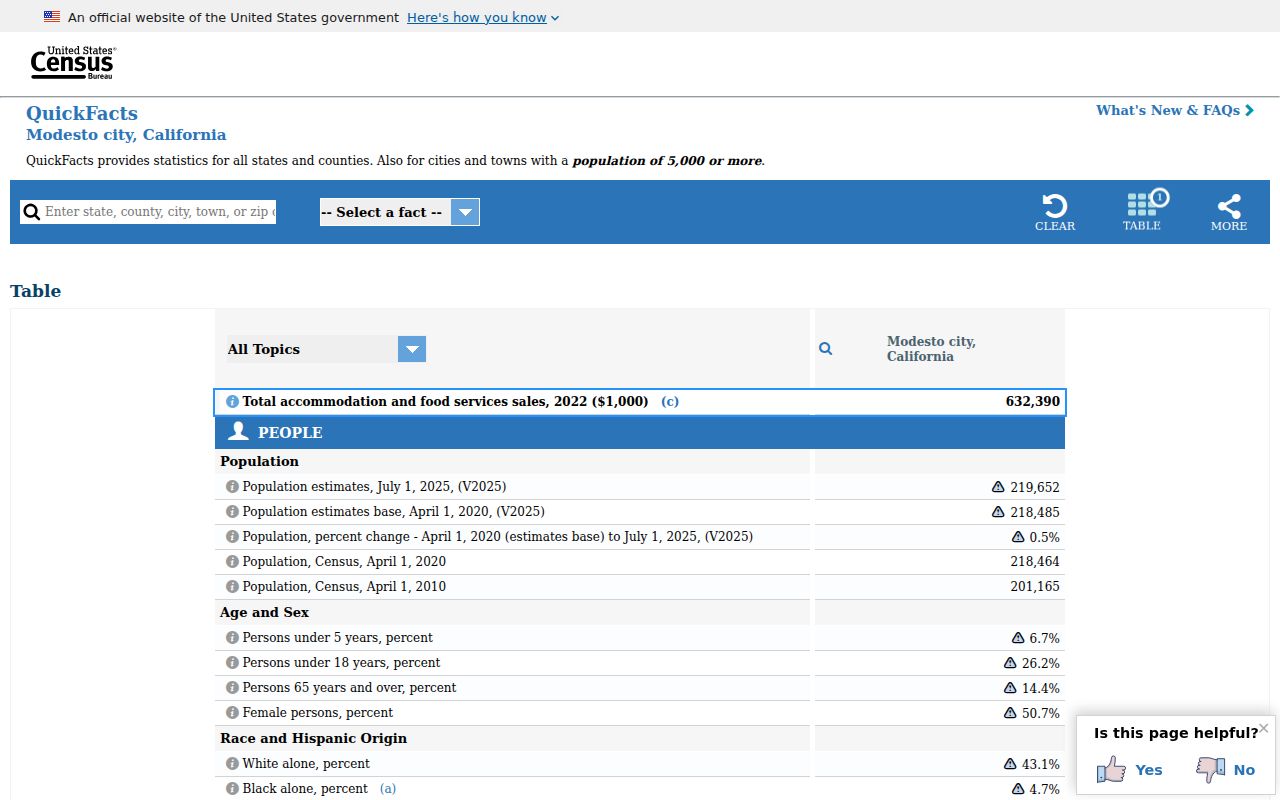
Use the census source for population and place context, then return to the directory volume for the name, address, occupation, and household clues recorded in that edition.
Modesto Directories Begin in 1910
Story: A Modesto city directory search can reach back to at least 1910. NARA’s official circa-1930 inventory identifies “Modesto - includes Stanislaus County, Turlock” for 1928-1933. That wording matters: the historical book may cover more than the city limits, and a person listed in a Modesto volume may be tied to a county town or nearby community.
Later Polk’s Modesto and Stanislaus County editions broaden the geographic frame. Catalog evidence names Turlock, Oakdale, Ceres, Denair, Hughson, Keyes, Riverbank, Salida, and other towns in later editions. That makes the publisher and edition year essential search fields. A surname that seems absent from a city-only scan may appear in a multi-community volume, or under a business entry rather than a household entry.
The historical sequence also reflects changes in the city. Downtown and the county-seat core are more likely to produce early institutional or commercial addresses. Graceada/Enslen and College Area have older residential fabric suited to directory, permit, and local-history research. A postal Modesto address on the rural fringe may fall in county jurisdiction, so directory coverage should not be treated as proof of city boundaries.
Polk’s Modesto Directory Towns
Polk’s volumes are useful because they can combine a household name series with a wider Stanislaus County geography. The 1960 edition’s inclusion of Turlock, Oakdale, Ceres, Denair, Hughson, Keyes, Riverbank, and Salida gives a researcher a way to test whether a move was local rather than a disappearance. Compare the town label, street, occupation, and spouse before treating two similar names as one person.
Search methods should follow the edition’s design. Start in the alphabetical section, then check any street-order or telephone section. A business listing may give a category, telephone number, and business address without establishing a home address. A directory can also repeat a name for a spouse, a roomer, or a person with the same surname. Dates, middle initials, occupations, and neighbors are the clues that sort those entries.
The NARA Modesto directory inventory is the best documented route for the 1928-1933 run. Its archive framing is different from a consumer database search: identify the title and years, then follow the repository’s microfilm or regional research process.
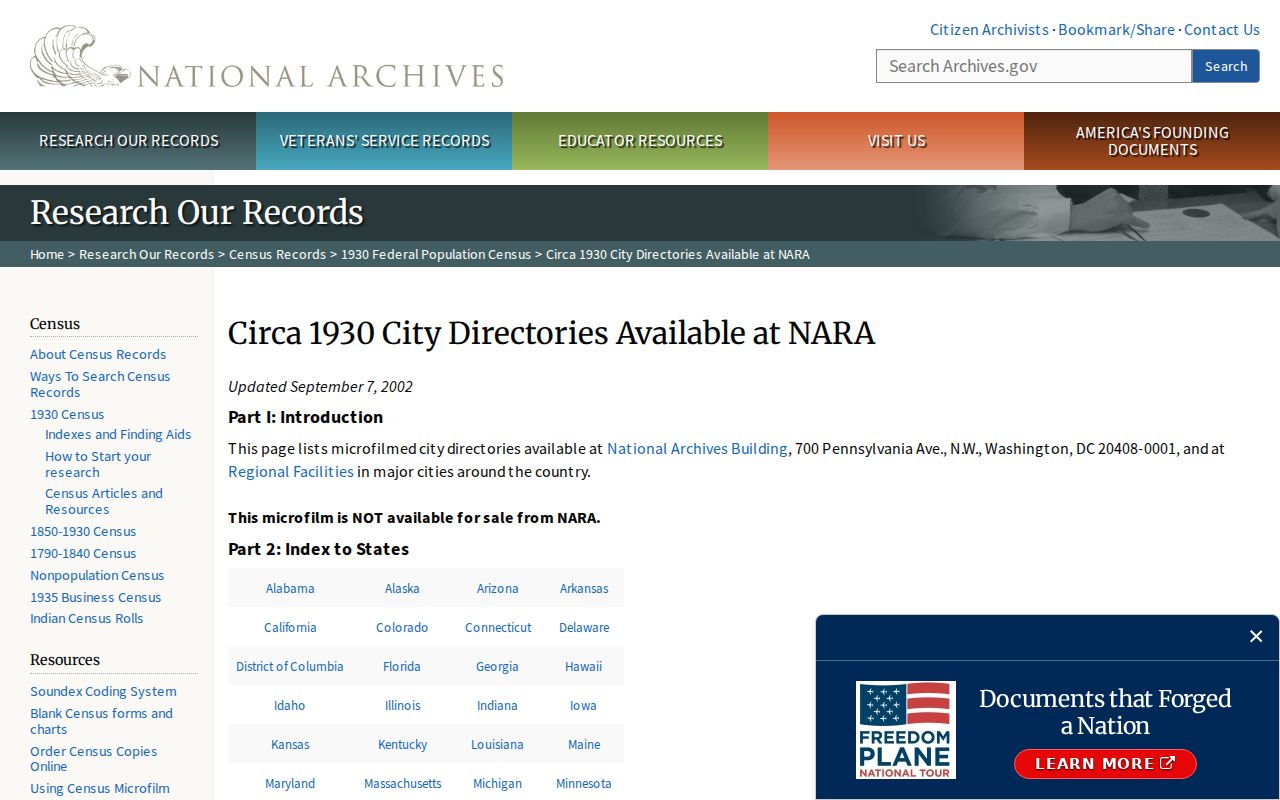
The NARA inventory image is a finding aid. It confirms a collection path, not that every page or image will be available for immediate online viewing.
Reading Modesto Directory Entries
A typical Polk Modesto entry should be read against the abbreviation key in that volume. The key may clarify whether a short mark refers to a home, a roomer, or a boarder. Do not silently expand an abbreviation from memory. Photograph or cite the key first, then preserve the printed form in notes.
| Surname and given name | Family name, given name, or initial; compare middle initials when names repeat. |
|---|---|
| Spouse notation | A spouse may appear in parentheses and can separate two same-name entries. |
| Widow notation | “Wid” followed by a name can point toward a death, obituary, cemetery, or probate trail. |
| Occupation and employer | Work or business affiliation helps distinguish people and can connect a family to local history. |
| Home indicator and address | “h” commonly signals a home address; “r” or “bds” may indicate a roomer or boarder, depending on the edition. |
| Business and telephone | Business entries may add a category, business address, and telephone number. |
- Criss-cross section
- A later directory section arranged by street and number instead of surname. It can place a household beside nearby numbered entries.
- Householder index
- An alphabetical name route into the main household listings. It may not include every person in a home.
- Abbreviation key
- The volume’s explanation of its marks and short forms. Editions differ, so the key belongs with the citation.
“h 123 Main” indicates a home at the printed address, not necessarily ownership. A woman’s absence under her own name may reflect publishing conventions rather than absence from the city. Treat every entry as a dated clue and corroborate it with another source.
Modesto Directory Criss-Cross
The criss-cross portion changes the question from “Which surname?” to “Who was recorded near this number?” Copy the target entry and a small run of adjacent numbers. That nearby sequence can show a likely block context, reveal a business beside a home, or expose a street-number change that deserves parcel and newspaper checking.
Use the street-order section with care. A directory’s address is a historical label, while Modesto’s countywide 1948 property-numbering plan changed the way numbers were assigned. Odd numbers are normally north or west, even numbers east or south, and one number was generally assigned per 25 feet of frontage. Legal descriptions, subdivision maps, and parcel identity are stronger bridges when an old number does not match a modern one.
For a present-day address-keyed search, move to the Modesto by-street records workflow rather than rebuilding modern parcel research inside a historical volume. The city directory remains the historical shelf: it can show a former household, occupation, or neighbor pattern that a current parcel search cannot.
Stanislaus Room Modesto Directory Research
The Modesto Library at 1500 I Street is the local first stop for physical collections. Its locked or supervised Stanislaus Room houses genealogy, California, Stanislaus County, and town histories. Request city directories by title and year, then ask about reverse directories, telephone books, high-school yearbooks, obituary indexes and clippings, county histories, cemetery publications, church pictorial directories, and newspaper microfilm.
Insider tip: Call the reference desk before traveling. Noncirculating directory volumes and supervised-room hours may not match the branch’s general schedule. A library card may be required for licensed genealogy databases, and some databases may require in-library use. The practical access chain is catalog title search, reference-desk help, Stanislaus Room access, Genealogical Society assistance, and then California State Library, NARA, or FamilySearch resources.
The Stanislaus County Library catalog and gateway is the starting point for local-history titles and branch channels. The image below is a visual reference for the library access route. It does not establish that any particular volume is on an open shelf.
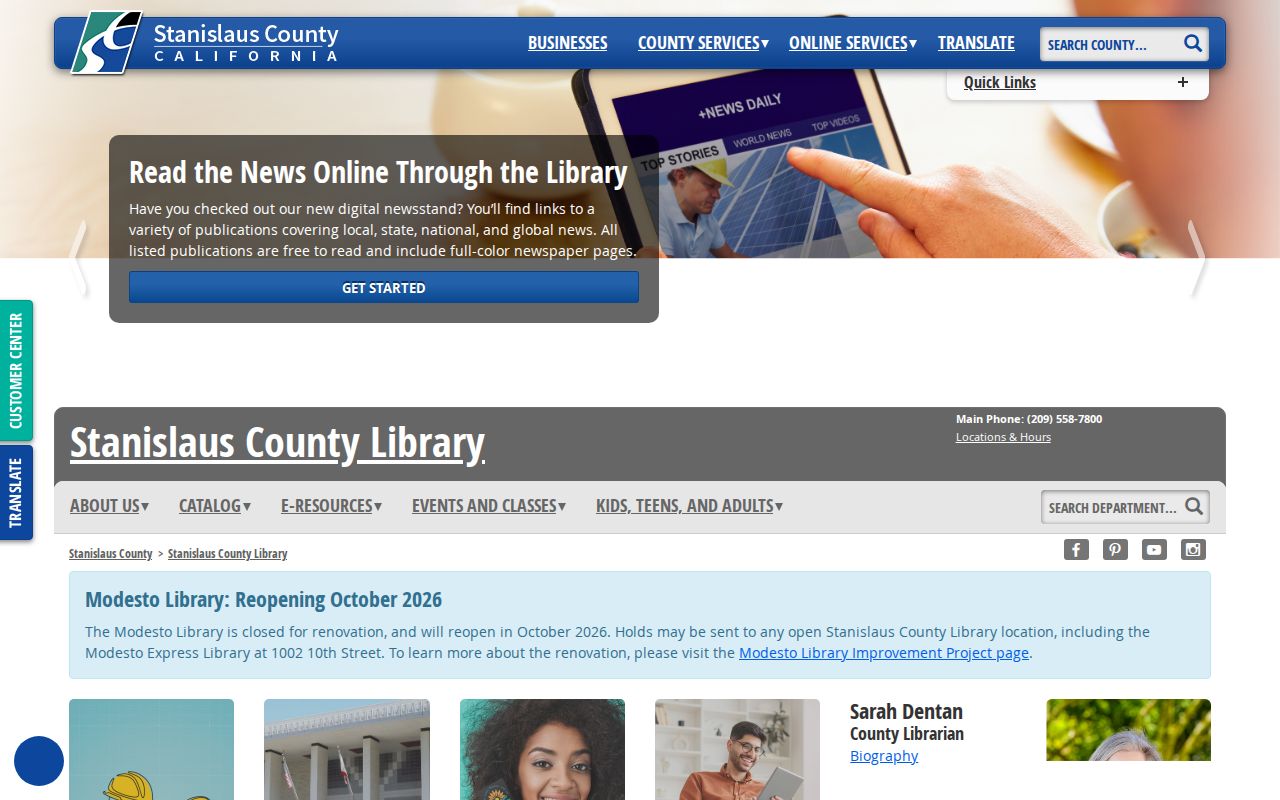
Ask staff to confirm location, handling rules, and whether a supervised appointment is needed before planning a directory session.
Modesto City Directory Genealogy Help
The Genealogical Society of Stanislaus County adds local knowledge to the catalog trail. Its research network and volunteer assistance can help interpret a surname file, county or town history, church directory, yearbook, cemetery publication, or other special-collection lead. The society is a research aid, not a public roster of current congregation members or households.
Church pictorial directories can preserve historical names and photographs. California State University, Stanislaus special collections may preserve yearbooks, student newspapers, faculty publications, and regional material through collection guides or requests. Modesto Junior College archives and library publications can add campus context. The 1938 “Industrial Modesto and Stanislaus County” title and local newspapers can connect a person to agriculture, food processing, education, government, or a community organization without treating an occupation as proof of identity.
Use the Genealogical Society of Stanislaus County for collection and research-support information. The image below points to that local help channel. Confirm user-contributed details with an obituary, cemetery record, deed, probate file, or other official source when a conclusion matters to an heir or family history.
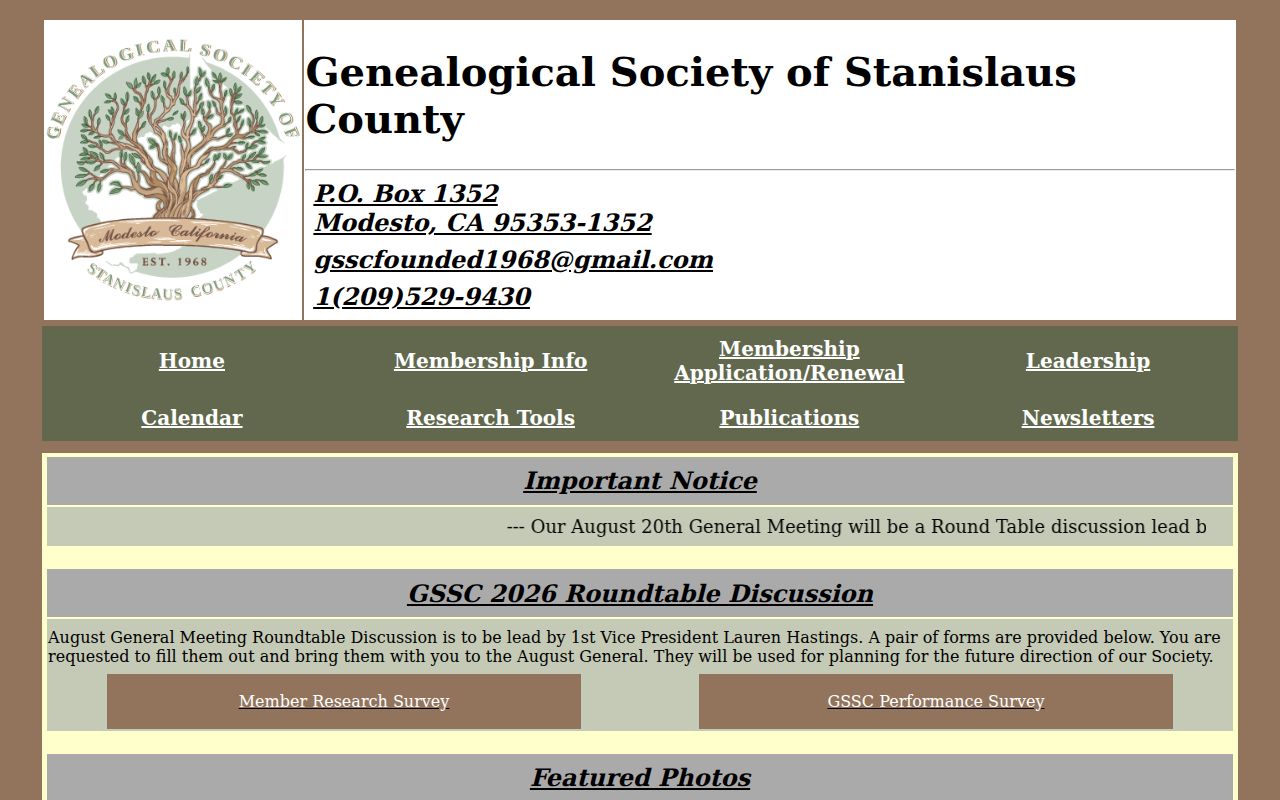
Local expertise is especially useful when an edition’s title, town coverage, or abbreviation key is unclear.
Modesto Directory Household Trail
A careful household search moves through editions rather than relying on one hit. Pair directory dates with the 1910, 1920, 1930, 1940, and 1950 federal censuses, remembering that a directory publication date may lag the census canvass. When a name vanishes, test a move, a missed edition, a change in household status, or a death instead of treating the absence as a final answer.
- Start with the alphabetical section and record every same-name candidate, middle initial, spouse, occupation, and address.
- Check the street or criss-cross section where available, copying nearby numbered entries for block context.
- Move one edition backward and forward, marking first appearance, moves, spouse or widow changes, and occupation changes.
- Pair the directory trail with the matching census and note gaps rather than filling them with assumptions.
- Use the 1948 numbering plan, legal description, subdivision map, or newspaper report when an address appears to change.
- Follow a final widow notation or disappearance into an obituary, cemetery, death index, probate record, later telephone book, or deed trail.
Telephone books are a strong bridge for the postwar gap. Verified Library of Congress runs cover November 1945 through February 1948, November 1948 through May 1950, March 1951 through February 1952, and county editions from 1953 into 1962. A telephone listing still reflects a subscriber record, not every resident in a household, so compare it with the historical city directory and census.
For a person who needs current corroboration after a historical find, use the Modesto resident lookup path and keep the older directory evidence separate from present records. The distinction protects the meaning of both sources and makes a family, heir, reconnecting, or civic-history search easier to audit.